
UAEStructuring and InvestmentUAE Foundations Series
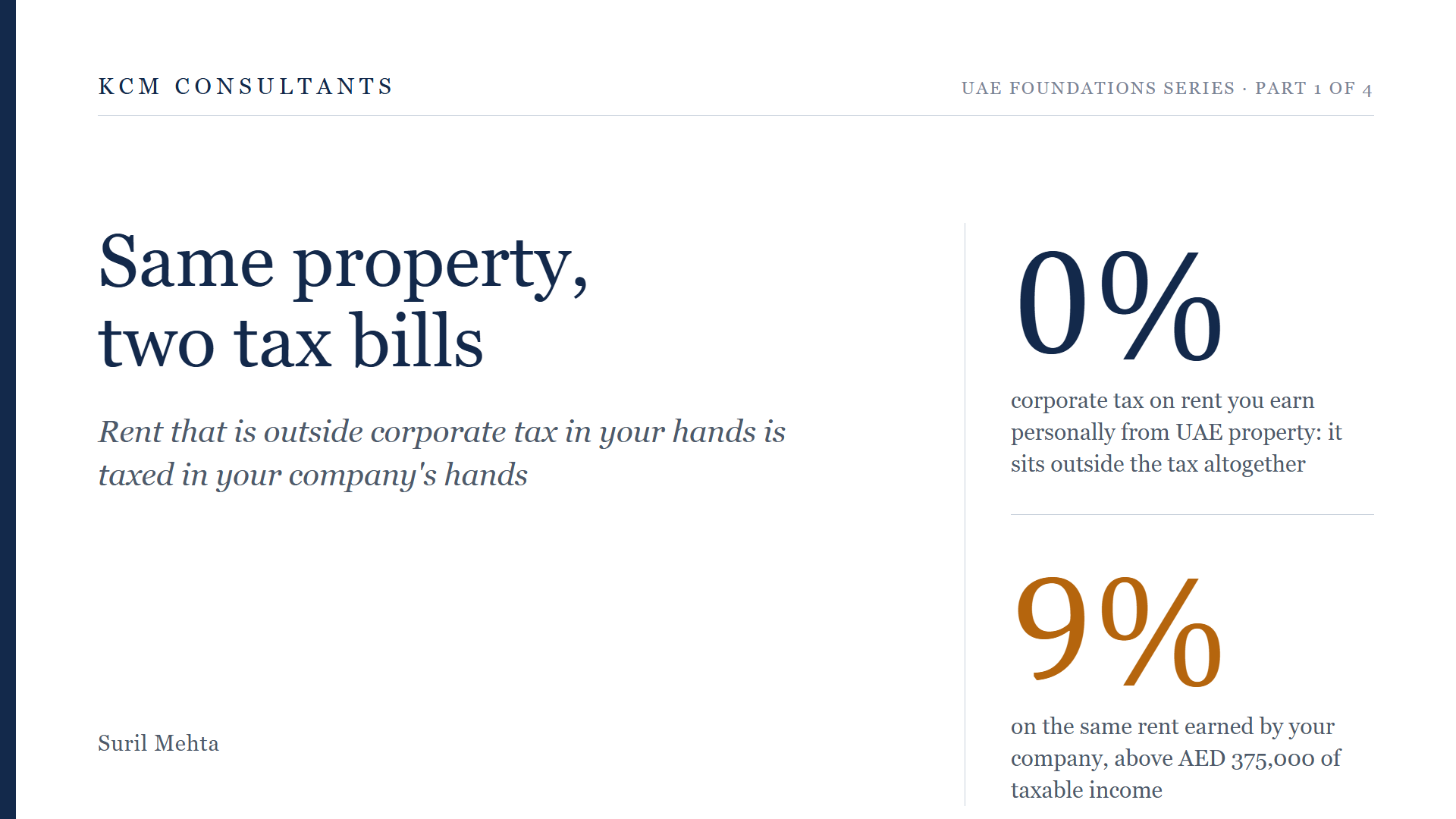
Same property, two tax bills
Rent that is outside corporate tax in your hands is taxed in your company's hands
By Suril Mehta, CA, Partner, K C Mehta & Co LLP | KCM Consultants LLC, Dubai
Published 16 November 20266 min
Take two friends who bought identical apartments in the same Dubai building a few years ago. One holds the flat personally. The other holds it through a company, because that is what the banker suggested at the time. Same building, same rent.
Today the first friend has no corporate tax (CT) exposure on that rent. The second friend’s company does. It is a taxable person: it has to register and file every year, and once its taxable income crosses AED 375,000, everything above that is taxed at 9%.
That isn’t a loophole. It is how the UAE law is written, and it is the white space this short series is about.
Why the individual is outside
The CT law reaches individuals only when they run a business, and even then only once business turnover crosses AED 1 million in a calendar year. Three kinds of income are kept out of that test altogether – wages, personal investment income and real estate investment income (Cabinet Decision 49 of 2023).
Real estate investment income is rent or sale proceeds from property you hold in your own capacity, as long as the activity is not done through a licence and does not need one. The FTA – Federal Tax Authority – says in its own guide that this holds regardless of the size, quantity or value of the property and the amount of income. Ten apartments or a hundred, the answer is the same. One trap for Dubai owners: a holiday home permit from the Department of Economy and Tourism counts as a licence.
Personal investment income works the same way for shares, bonds, deposits and other investments you manage for your own account, as long as it is not run as a trade or under a licence.
A company gets none of this
For a company there is no such thing as personal investment. Rent, gains on a sale, bank interest, gains on crypto or art – all of it goes into taxable income. 0% on the first AED 375,000, 9% on the rest.
A few exemptions survive. Dividends from UAE companies are exempt. Dividends and gains on larger shareholdings are exempt if the stake is 5% or more (or cost at least AED 4 million), it is held for 12 months, and a few other tests are met. A normal portfolio of listed shares rarely gets there, and bonds and crypto never do, since the exemption is only for shareholdings.
Same income, two owners
| Income | Held by you | Held by your UAE company |
|---|---|---|
| Rent from UAE property, no licence needed | Outside CT | Taxable |
| Gain on selling that property | Outside CT | Taxable; gains from before the company's first tax period may be excluded by election |
| Dividends from UAE companies | Outside CT | Exempt |
| Dividends and gains on small stakes in foreign shares | Outside CT | Taxable; exempt only if the stake is 5% or more (or cost AED 4 million or more), is held for 12 months and other tests are met |
| Interest on deposits and bonds | Outside CT | Taxable |
| Gains on crypto, art and watches held as investments | Outside CT | Taxable |
To put a number on it: a company with AED 4 million of rent and AED 800,000 of costs has taxable income of AED 3.2 million. Tax is 9% of (3,200,000 – 375,000), which is AED 254,250 every year. Held in the owner’s own name, the same flats would carry no UAE corporate tax at all.
So why are the assets in companies at all?
Usually for reasons that had nothing to do with tax, since most of these structures are older than CT. Siblings who wanted to hold together. A bank that preferred a corporate borrower. Privacy. Succession. A non-resident owner who was told a company was simpler. Those reasons may still be good ones. The tax cost around them has changed.
For smaller companies the cost is still hidden. A company whose revenue has stayed at or below AED 3 million in every tax period can elect Small Business Relief and be treated as having no taxable income, and in July 2026 the Ministry of Finance extended that relief to tax periods ending on or before 31 December 2029 (Ministerial Decision 131 of 2026). So the gap bites hardest today on larger portfolios, and on everyone else once their tax periods run past 2029.
The bridge
The obvious fix – take the property out of the company – has its own price. The company is treated as selling at market value and the gain is taxed there and then. More on that in Part 3.
There is a better bridge in the law itself. Article 17 of the CT law lets a family foundation (a separate legal entity set up to hold a family’s assets) apply to the FTA to be treated as transparent, meaning see-through for tax, and under Ministerial Decision 261 of 2024 a company wholly owned and controlled by a foundation that has been approved can apply too. When it works, the rent and gains are treated as the family members’ own income, which puts them back where an individual would be – outside CT. When it doesn’t work, it is usually because of a condition that looked like a formality.
How that works, and the condition that most often fails, is Part 2 of this series.
Before any of that, the most useful exercise is a boring one: list what sits in your own name, what sits in a company, and why it went there. In most of the conversations we have had on this, that list answered half the questions before anyone got to tax.
References
- UAE Ministry of Finance, Federal Decree-Law No. 47 of 2022 on the Taxation of Corporations and Businesses, with amendments (consolidated text, January 2026) (Articles 17, 22 and 23).
- Federal Tax Authority, Cabinet Decision No. 49 of 2023 (natural persons conducting business).
- UAE Ministry of Finance, Cabinet Decision No. 116 of 2022 (the AED 375,000 threshold).
- UAE Ministry of Finance, Ministerial Decision No. 73 of 2023 on Small Business Relief.
- UAE Ministry of Finance, Ministerial Decision No. 131 of 2026 amending Ministerial Decision No. 73 of 2023 on Small Business Relief.
- UAE Ministry of Finance, Ministerial Decision No. 261 of 2024 on Unincorporated Partnership, Foreign Partnership and Family Foundation.
- Federal Tax Authority, Taxation of Natural Persons, Corporate Tax Guide CTGTNP1.
- Federal Tax Authority, Real Estate Investment for Natural Persons, Corporate Tax Guide CTGREI1.
Related
- UAE Foundations Series · Part 2 of 4UAESuccession Planning and Foundations
How a UAE foundation closes the gap
When a DIFC, ADGM or RAK ICC foundation and the company under it can be treated as transparent for UAE corporate tax, and the condition that most often fails.
Suril Mehta16 Nov 2026 · 7 min - UAE Tax & RestructuringUAEStructuring and Investment
UAE Tax & Restructuring
A series by Suril Mehta, CA on UAE corporate tax for promoters and family offices: group restructuring reliefs and family foundations, linked to the law.
Suril Mehta16 Nov 2026 · 3 min