
UAESuccession Planning and FoundationsUAE Foundations Series
Getting the assets in is where the tax sits
Who owns the asset today decides most of the cost of moving it into a foundation
By Suril Mehta, CA, Partner, K C Mehta & Co LLP | KCM Consultants LLC, Dubai
Published 16 November 20267 min
Most of the tax in a foundation structure is paid on the way in. Once assets sit inside an approved structure the UAE corporate tax position is simple. Getting them there is where the money is, and who owns the asset today decides almost all of it.
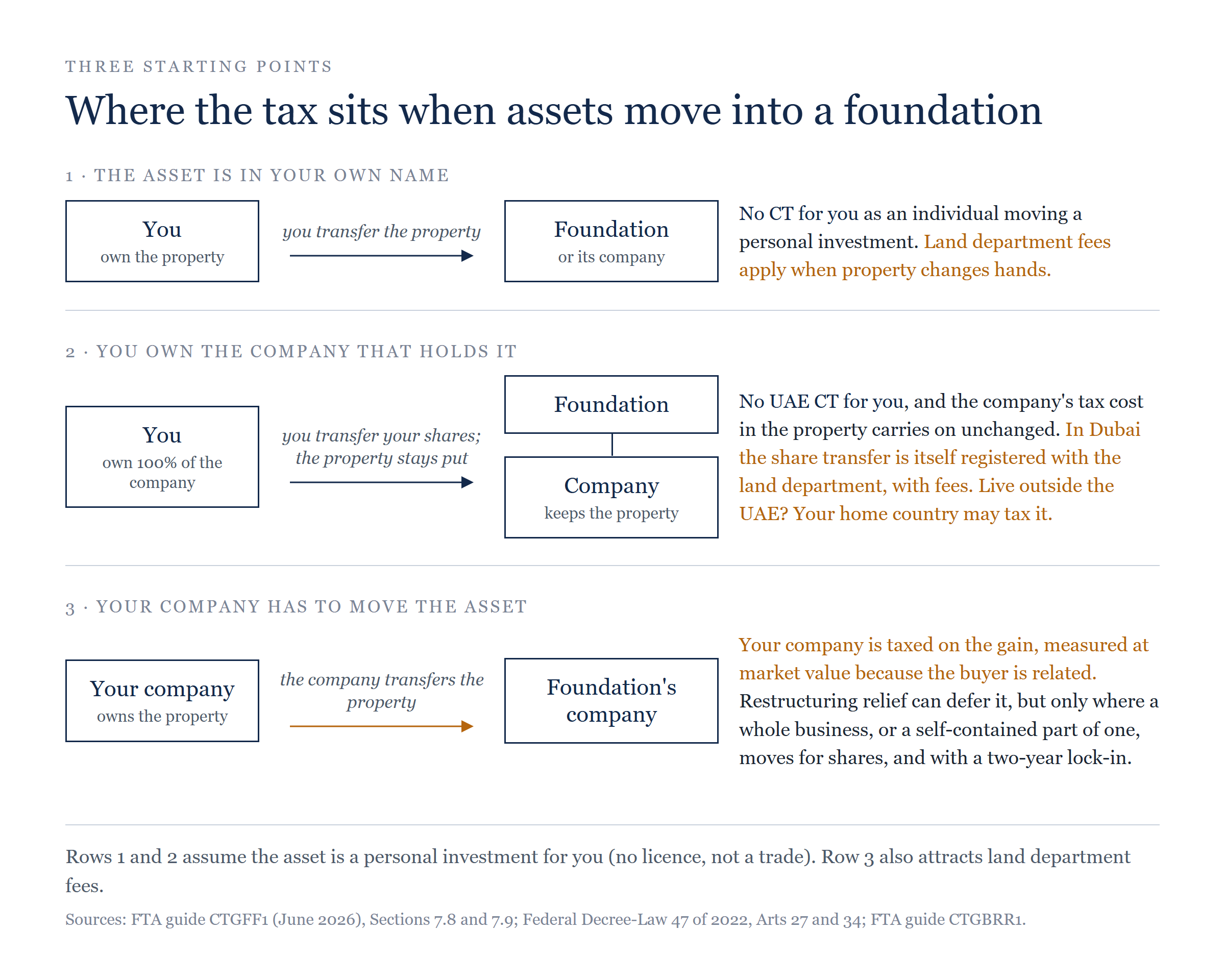
Figure 1 · Three starting points
Read across each row: who owns the asset today, what moves, and where the tax falls.
How to read this diagram
- The asset is in your own name. You transfer the property to the foundation or its company. No corporate tax for you as an individual moving a personal investment. Land department fees apply when property changes hands.
- You own the company that holds it. You transfer your shares and the property stays put. No UAE corporate tax for you, and the company’s tax cost in the property carries on unchanged. In Dubai the share transfer is itself registered with the land department, with fees. If you live outside the UAE, your home country may tax it.
- Your company has to move the asset. The company transfers the property to the foundation’s company and is taxed on the gain, measured at market value because the buyer is related. Restructuring relief can defer it, but only where a whole business, or a self-contained part of one, moves for shares, and with a two-year lock-in. Land department fees apply here too.
- The first two routes assume the asset is a personal investment for you (no licence, not a trade).
If the asset is already in your name
Moving your own property or portfolio into the foundation, or into a company under it, is not a corporate tax (CT) event for you, as long as you hold it as an investment rather than run it as a licensed business. The FTA (Federal Tax Authority) guide says so directly: an individual transferring personal or real estate investments is not subject to CT on the transfer.
The land department is a different matter. In Dubai a sale is registered at 4% of value, normally split between buyer and seller, and a registered gift at 0.125% (minimum AED 2,000). The DLD (Dubai Land Department) offers the gift rate for transfers to parents, a spouse or children, or to companies, and lists only UAE citizens and residents as donors, so which rate applies to a move into a foundation or its company is worth settling with the DLD before you rely on the lower one. Also check that the receiving entity can hold Dubai title at all: DIFC (Dubai International Financial Centre) and ADGM (Abu Dhabi Global Market) foundations can, in Dubai’s freehold areas, under arrangements between the DLD and each centre. For a foundation registered elsewhere, confirm the position with the DLD first.
If you own the company that holds it
This is usually the cleaner route. You move your shares in the company to the foundation. The company sells nothing, so it has no gain to tax. In its family foundations guide (CTGFF1), as updated in June 2026, the FTA added that when a company becomes wholly owned by a family foundation and is approved as see-through, the tax cost of its assets (the figure any gain is measured from) is not reset. Turning see-through is not treated as the company selling anything, and its existing cost carries on.
One thing this route does not avoid is the land department. In Dubai a change in the shareholders of a company that owns property is registered with the DLD, and its published fee for a share sale is the same 2% plus 2% as a property sale. Get the DLD’s position on a transfer to a foundation in writing before you count the saving.
The other catch is your home country. If you are UAE resident, nobody usually taxes the share transfer. If you are not, the answer can be very different. South Africa treats a gift of the shares as if they were sold at market value and can add donations tax on top. India’s exchange control rules do not let a resident individual gift overseas shares to anyone outside India. Kenya, which taxes only Kenyan-source gains, usually has no claim on it. None of these countries looks at the FTA’s approval; each applies its own rules to the foundation.
If your company has to move the asset itself
This is the expensive one, and it is where many families with older structures sit. The company is a taxable person. The foundation, or its company, will almost always be a related party, so the transfer is measured at market value whatever price goes into the contract, and the company pays 9% on the gain. If the property was owned before the company’s first tax period, part of that gain may be protected, but only if the company made that election in its first CT return, and the election cannot normally be undone. And the land department fee applies again.
The law does have restructuring reliefs that move a whole business, or a self-contained part of one, at book value (the figure in the accounts), so no gain arises at that point. Business restructuring relief (Article 27) needs the company to be paid in shares, and if any of those shares are transferred within two years, even one, the relief reverses and the whole transfer is taxed at its original market value. Group relief (Article 26) needs a 75% ownership link, either between the two companies or through a common owner. Nobody owns a foundation, so a company you own and a company your foundation owns are not a group.
Both can still be part of an answer. Neither is a one-step fix, and a structure that clears these rules on day one has to keep clearing them for two years. If someone shows you a one-step route for a company-held property, ask what happens if one share moves in month 13.
I am deliberately not drawing the routes here. They turn on residence, values, timing and documentation, and a generic route map would mislead more readers than it would help.
The last part of this series: seven questions to answer before you move anything.
References
- Federal Tax Authority, Taxation of Family Foundations, Corporate Tax Guide CTGFF1 (June 2026) (Sections 7.8 and 7.9).
- UAE Ministry of Finance, Federal Decree-Law No. 47 of 2022 on the Taxation of Corporations and Businesses, with amendments (consolidated text, January 2026) (Articles 26, 27 and 34).
- UAE Ministry of Finance, Ministerial Decision No. 120 of 2023 on adjustments under the transitional rules.
- UAE Ministry of Finance, Ministerial Decision No. 133 of 2023 on Business Restructuring Relief.
- Federal Tax Authority, Business Restructuring Relief, Corporate Tax Guide CTGBRR1.
- Government of Dubai, Executive Council Resolution No. (30) of 2013 Approving Fees of the Land Department.
- Dubai Land Department, Property sale registration.
- Dubai Land Department, Property gift registration.
- Dubai Land Department, Company shares sale.
Related
- UAE Foundations Series · Part 2 of 4UAESuccession Planning and Foundations
How a UAE foundation closes the gap
When a DIFC, ADGM or RAK ICC foundation and the company under it can be treated as transparent for UAE corporate tax, and the condition that most often fails.
Suril Mehta16 Nov 2026 · 7 min - UAE Foundations Series · Part 4 of 4UAESuccession Planning and Foundations
Seven questions before you move anything
A short self-check for families considering a UAE foundation for property and investments, including when corporate tax gives you no reason to move anything.
Suril Mehta16 Nov 2026 · 6 min