
UAE-IndiaBusiness Tax
UAE Top-up Tax (Pillar 2) for Indian groups: who must register, by when, and how a deal can bring you in
By Suril Mehta, CA, Partner, K C Mehta & Co LLP | KCM Consultants LLC, Dubai
Published 16 November 20266 min
This version is for Indian groups with companies or branches in the UAE. For US groups, see the version for US groups, with the dollar test and the side-by-side deal.
In short
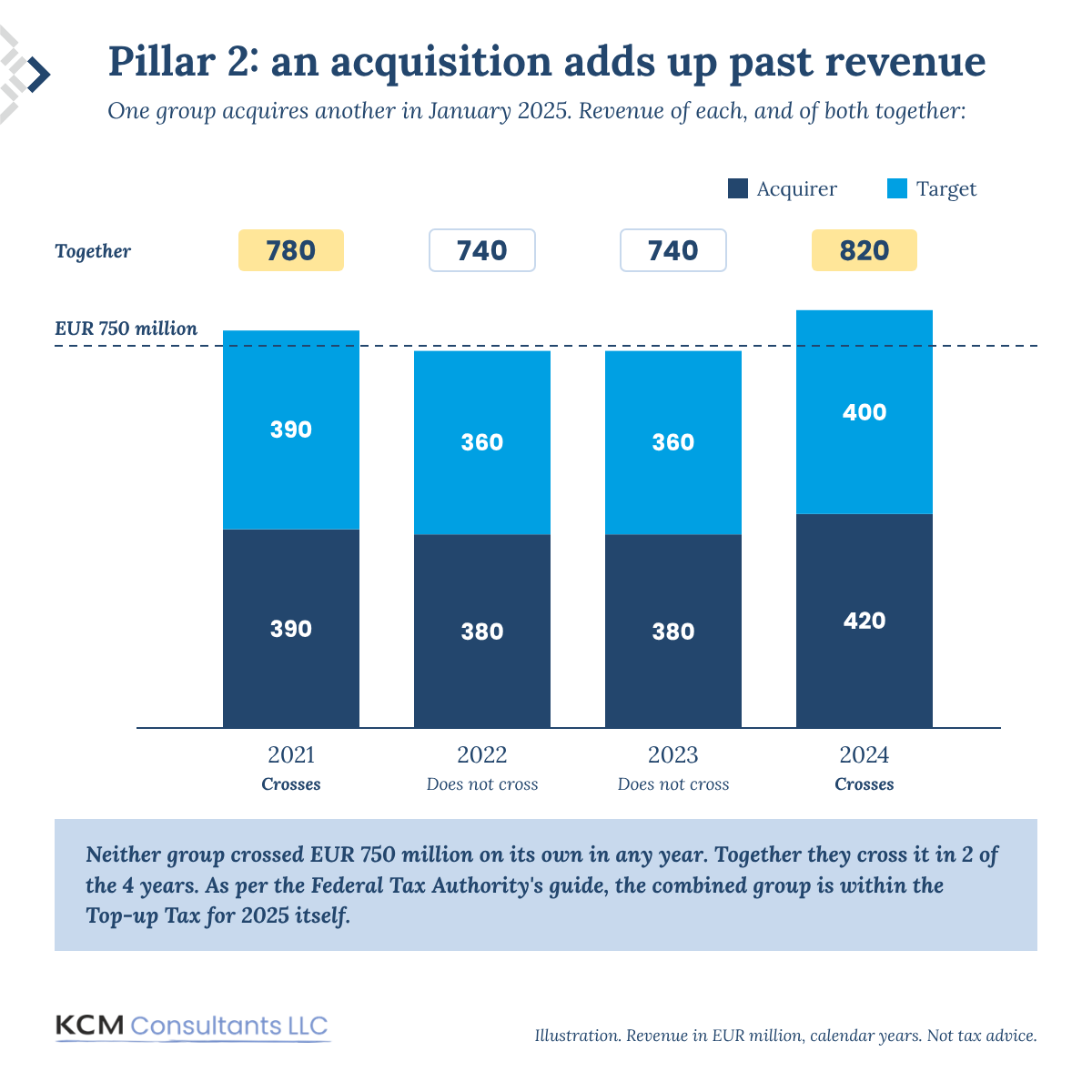
Neither group ever had EUR 750 million in revenue. After one acquired the other, the UAE’s Pillar 2 rules treat them as if they had, and every UAE company of the combined group has to register for the UAE’s 15% Top-up Tax. For a group with a 31 March year end, the last date is 30 November 2026.
- It is a separate registration. The Corporate Tax registration does not cover it, and it is needed even where no Top-up Tax is payable.
- The group is tested, not the UAE company. A UAE company with revenue of ₹10 crore is within it if its group is.
- India not having Pillar 2 does not help. The UAE applies its own rules to the UAE companies of any group that is in, wherever the parent is.
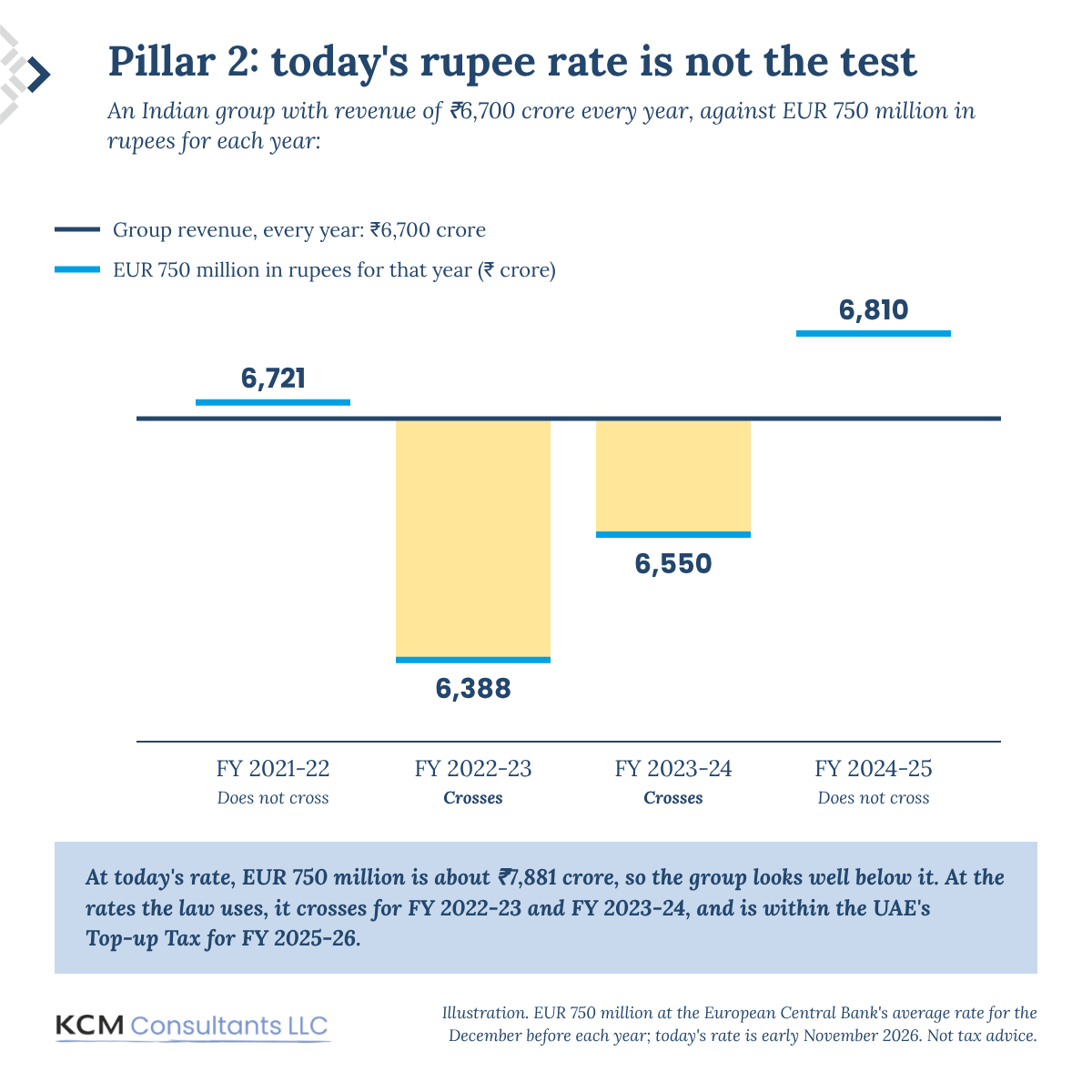
- Today’s rupee rate is not the test. At today’s rate, EUR 750 million is about ₹7,881 crore. The law converts it at the rate of the December before each year: about ₹6,388 crore to ₹6,810 crore for FY 2021-22 to FY 2024-25.
- A deal can change the answer. An acquisition, merger or demerger in the last 4 years can bring in a group whose own accounts never crossed EUR 750 million.
- Missing the date costs AED 10,000 (about ₹2.5 lakh) for each UAE entity.
This note is for CFOs, tax heads and promoters of Indian groups with a company or a branch in the UAE. It covers who has to register, by when, the rupee trap, how a merger or demerger changes the test, and what to keep ready.
Is your group in? Five questions
If any answer puts the group in, every UAE company and branch of the group has to register.
- Is the group multinational? It needs at least one company or branch outside the country of its ultimate parent. An Indian group with a UAE company already is.
- Did consolidated revenue reach EUR 750 million in at least 2 of the 4 years before the year being tested? For a 31 March year end, testing FY 2025-26, those years are FY 2021-22 to FY 2024-25.
- Did the group acquire, or merge or amalgamate with, another group in those years? Then add the other group’s revenue for each year before the deal, and test again.
- Did the group come out of a demerger of a group that was in? Then look at its own revenue in the first year ending after the demerger.
- Did you convert at the right rate? EUR 750 million is converted at the December rate before each year being looked at, not at today’s rate.
How the EUR 750 million test works
The Top-up Tax is the UAE’s version of the 15% global minimum tax under Pillar 2. It applies for years starting on or after 1 January 2025, to the UAE companies and branches of a multinational group whose revenue was EUR 750 million or more in at least 2 of the 4 years before the year being tested. For a group with a 31 March year end, the first such year is FY 2025-26.
- The revenue is the group’s. It is taken from the consolidated accounts of the ultimate parent, wherever that parent is. The UAE company’s own size does not matter.
- The test runs every year. For FY 2025-26 it looks at FY 2021-22 to FY 2024-25; for FY 2026-27, at FY 2022-23 to FY 2025-26. A group can come in, and go out, as its revenue moves.
- A short year is scaled. Where a year is not 12 months, the EUR 750 million is reduced in proportion.
- The group must be multinational. A group with all its companies in the UAE is outside. One subsidiary or branch abroad, or a foreign parent, changes that.
This may be highly non-intuitive, but the figures used for the test are not always the figures in your accounts. The rupee value of the test changes every year, and after an acquisition, merger or demerger, the law adjusts the revenue history. The sections below show how.
The rupee trap: today’s rate is not the test
EUR 750 million is converted for each year at the European Central Bank’s average rate for the December before that year starts. With the rupee weaker today than in 2020 to 2023, a group that checks at today’s rate can wrongly conclude that it is out.
| Year (April to March) | Rate used (₹ per EUR, December before) | EUR 750 million in rupees |
|---|---|---|
| FY 2021-22 | 89.6081 (December 2020) | about ₹6,721 crore |
| FY 2022-23 | 85.1762 (December 2021) | about ₹6,388 crore |
| FY 2023-24 | 87.3381 (December 2022) | about ₹6,550 crore |
| FY 2024-25 | 90.8009 (December 2023) | about ₹6,810 crore |
An Indian group with revenue of ₹6,700 crore every year crossed EUR 750 million for FY 2022-23 and FY 2023-24, so it is in for FY 2025-26, and its UAE companies register by 30 November 2026. At early November 2026 rates (about ₹105 per euro), EUR 750 million is about ₹7,881 crore, and the same group would look about ₹1,181 crore short.
India not having Pillar 2 does not keep you out. India has not introduced the Pillar 2 rules. That does not keep an Indian group’s UAE companies out of the UAE’s Top-up Tax: the UAE tests the group, wherever its parent is.
Promoter family groups. Companies held directly by family members, with no common parent company, are separate groups for this test. If they are later brought under one holding company, run the test again.
Who has to register
If the group is in, each of its UAE entities registers on its own, on the Federal Tax Authority’s (FTA) EmaraTax portal. The common surprises are below.
| UAE entity of an in-scope group | Has to register? | Why it is missed |
|---|---|---|
| Mainland company | Yes | Its own revenue may be small |
| Free zone company paying 0% | Yes | No tax is paid, so it looks out of scope |
| Dormant company | Yes | It does no business, but it is still a group company |
| Branch of a foreign group company | Yes | It is not a separate company |
| Joint venture | Yes, on its own, as per the FTA’s guide | It may not be consolidated line by line |
- The Corporate Tax registration does not cover it. This is a separate registration, with its own number.
- No tax to pay does not mean no registration. A group whose UAE profits already bear 15% or more, or which falls in a safe harbour, still registers.
As per the FTA’s guide on scope and registration, a penalty of AED 10,000 (about ₹2.5 lakh) applies for each entity that does not register in time.
The dates
Each UAE entity registers within 7 months after the end of the group’s first year in scope. Where that year ended before 30 April 2026, the last date is 30 November 2026.
| Group’s year ends on | First year in scope | Last date to register |
|---|---|---|
| 31 March (most Indian groups) | 1 April 2025 to 31 March 2026 | 30 November 2026 |
| 31 December | 1 January to 31 December 2025 | 30 November 2026 |
| 30 June | 1 July 2025 to 30 June 2026 | 31 January 2027 |
| 30 September | 1 October 2025 to 30 September 2026 | 30 April 2027 |
The same 7-month rule applies later on:
- A group that comes in for a later year registers within 7 months after the end of that year.
- A UAE company that joins an in-scope group, for example on an acquisition, registers within 7 months after the end of the year in which it joins.
- A UAE entity that is closed, or leaves the group, deregisters within 6 months. For one that ceased before 30 June 2026, the date is 31 December 2026. The FTA does not deregister an entity until its tax, penalties and returns are settled.
Deals that change the answer
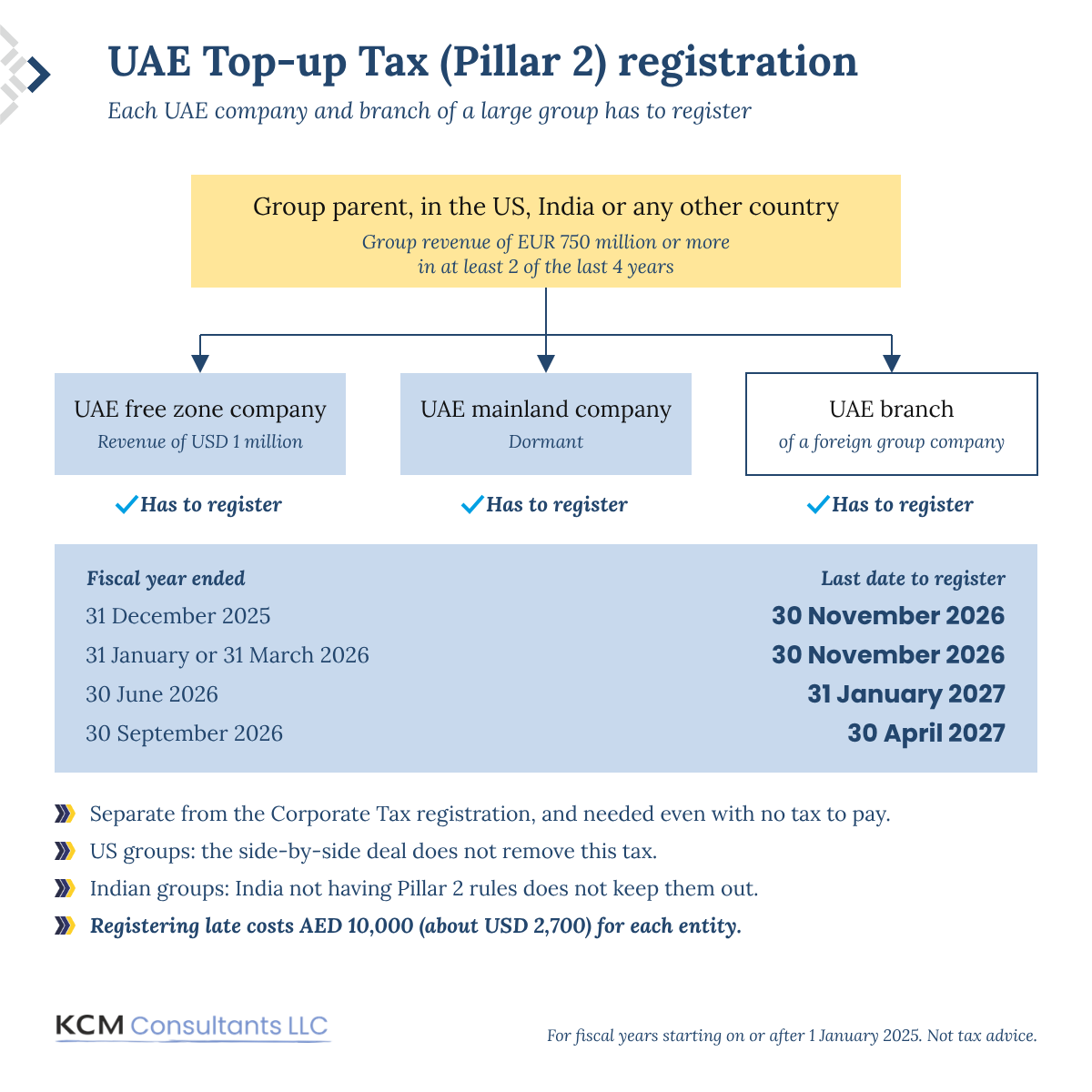
If your group did an acquisition, merger, amalgamation or demerger in the last 4 years, do not go by its consolidated revenue alone. Run the test again with the deal in it.
An acquisition or merger of two groups
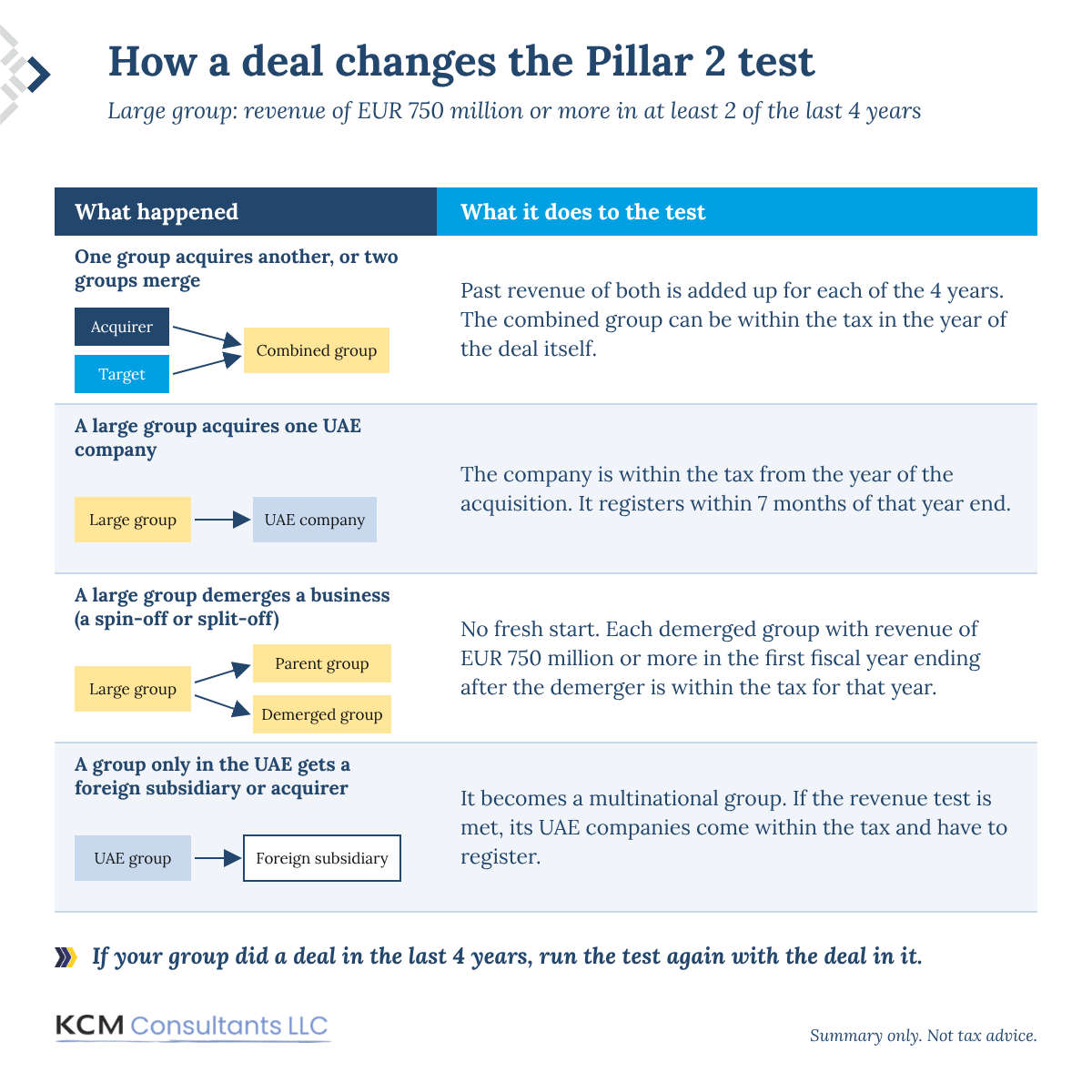
For each year before the deal, the revenue of BOTH groups is added up, as if they had always been one group. In your accounts, the target’s revenue comes in only from the closing date. For this test, it counts for the earlier years as well. This covers a takeover of another group, and an amalgamation of two groups under a scheme. An amalgamation of two companies already in the same group changes nothing: they were one group already.
| Year | Acquirer (EUR million) | Target (EUR million) | Together (EUR million) | EUR 750 million crossed? |
|---|---|---|---|---|
| 2021 | 390 | 390 | 780 | Yes |
| 2022 | 380 | 360 | 740 | No |
| 2023 | 380 | 360 | 740 | No |
| 2024 | 420 | 400 | 820 | Yes |
Neither group crossed EUR 750 million on its own. One acquires the other in January 2025. Together they crossed it in 2 of the 4 years, so as per the FTA’s guide, the combined group is in for 2025, the year of the deal itself. The example uses calendar years; for an April to March group, read FY 2021-22 for 2021, and so on.
Keep in mind 2 things:
- The FTA’s guide applies this even where the deal falls in the year being tested. The Cabinet Decision speaks of a merger in one of the 4 earlier years, so a deal in the tested year deserves a second look.
- The rule is written for two groups coming together. Buying only part of another group, such as one of its subsidiaries, is not a merger for this rule: that business counts only from when it is consolidated.
Acquiring one UAE company
A UAE company acquired by an in-scope group is in from the year of the acquisition. It registers within 7 months after that year ends: for a group with a 31 March year end that acquires it in FY 2026-27, by 31 October 2027.
A demerger
A demerger, for this rule, is one group separating into two or more groups that are no longer consolidated by the same parent. In India this is usually a demerger under a scheme approved by the National Company Law Tribunal (NCLT), where the shareholders of the demerged company get shares in the resulting company. A group that was in does not get a fresh start:
- First year after the demerger. Each demerged group is in if its revenue for the first year ending after the demerger is EUR 750 million or more.
- Second to fourth years. Each is in if its revenue was EUR 750 million or more in at least 2 of the years after the demerger.
A demerger between two companies that stay under the same parent is not a demerger for this rule, and nor is a carve-out where the parent keeps control. The group stays one group. The same holds where a promoter holding company controls, and consolidates, both companies after the demerger.
A group only in the UAE becomes multinational
A group with all its companies in the UAE is outside, however large. It becomes multinational when it sets up or buys a company or branch abroad, or when a foreign group acquires it. This matters for families whose UAE group sets up or buys a company in India. As per the FTA’s guide, a UAE group acquired by a foreign company in 2025 can be in for 2025 itself.
After registration
Registration is the first step. The first Top-up Tax return is due 18 months after the end of the first year in scope, and 15 months after the year end for later years: for a group with a 31 March year end, 30 September 2027 for FY 2025-26.
What to keep ready now:
- Consolidated revenue for the last 4 years, adjusted for any acquisition, merger, amalgamation or demerger.
- A list of every UAE company, branch and joint venture of the group, with its licence and Corporate Tax number.
- The group chart up to the ultimate parent.
- For the return: the UAE accounts, the taxes paid, and the payroll and assets in the UAE, which reduce the profit that can be topped up.
How we can help
We work across India, the UAE and the US, so we see these groups from both ends: the Indian parent’s accounts and the UAE companies.
- Confirm scope. We run the EUR 750 million test for each year, with your acquisitions, mergers and demergers in it, at the right exchange rates.
- Register each UAE entity. Companies, branches and joint ventures, before your last date.
- Plan the first return. We map the data the return needs, so the 2027 filing is not a scramble.
Write to connect@kcmehta.ae, or see our UAE Corporate Tax Advisory and Transaction Structuring services.
We are hiring in Dubai and India for UAE corporate tax, audit, succession planning and business development. See Careers.
Questions we are being asked
Our UAE company has revenue of only AED 2 million. Does it still have to register? Yes, if its group is in. The test looks at the group’s revenue, not the UAE company’s.
At today’s rate we are well below EUR 750 million. Are we out? Not necessarily. The test converts EUR 750 million at the December rate before each year: about ₹6,388 crore for FY 2022-23 and ₹6,550 crore for FY 2023-24, against about ₹7,881 crore today.
India has not introduced Pillar 2. Does that help an Indian group? No. The UAE applies its own rules to the UAE companies of any group that is in.
We already have a Corporate Tax registration. Is that enough? No. The Top-up Tax registration is separate.
We expect to pay no Top-up Tax. Do we still register? Yes. Registration does not depend on tax being payable.
Our group never crossed EUR 750 million, but we amalgamated with another group in FY 2022-23. Could we be in? Yes. The two groups’ revenue is added up for each year before the deal. Run the test with both.
We demerged a business under an NCLT scheme in 2024. Does the resulting group start afresh? No. If the group was in, each demerged group with revenue of EUR 750 million or more in its first year ending after the demerger is in for that year. If both companies stay under the same parent, the group was never split.
What does it cost to miss the date? AED 10,000 (about ₹2.5 lakh) for each UAE entity, as per the FTA’s guide.
Related reading
- UAE Top-up Tax (Pillar 2) for US groups: the same rules, with the dollar test and the side-by-side deal
- 31 December: five UAE tax deadlines fall on one day
- Pillar One and Pillar Two: strengthening the foundation
References
- Cabinet Decision No. 142 of 2024 on the Top-up Tax: Article 1.1 for the EUR 750 million test, Article 6.1 for mergers and demergers.
- FTA Decision No. 12 of 2026 on registration dates (KPMG summary).
- FTA guide on Top-up Tax scope and registration (TTGREG1).
- Exchange rates: European Central Bank reference rates, December monthly averages (Banque de France, December 2023).
Current as at 16 November 2026. This note is general information, not tax advice.
Related
- UAEBusiness Tax
UAE Top-up Tax (Pillar 2) for US groups: who must register, by when, and how a deal can bring you in
USD 850 million is not the test. Who registers for the UAE’s Top-up Tax, by when, and how a deal can bring a US group in.
Suril Mehta16 Nov 2026 · 5 min - UAEBusiness Tax
UAE tax updates, November 2026: e-invoicing penalties, top-up tax and the 31 December deadlines
E-invoicing starts 1 January 2027 with new penalties, top-up tax registration closes 30 November, and five UAE tax deadlines fall on 31 December.
Suril Mehta16 Nov 2026 · 15 min