
UAEBusiness Tax
E-invoicing: new penalties, same start date
By Suril Mehta, CA, Partner, K C Mehta & Co LLP | KCM Consultants LLC, Dubai
Published 13 November 20262 min
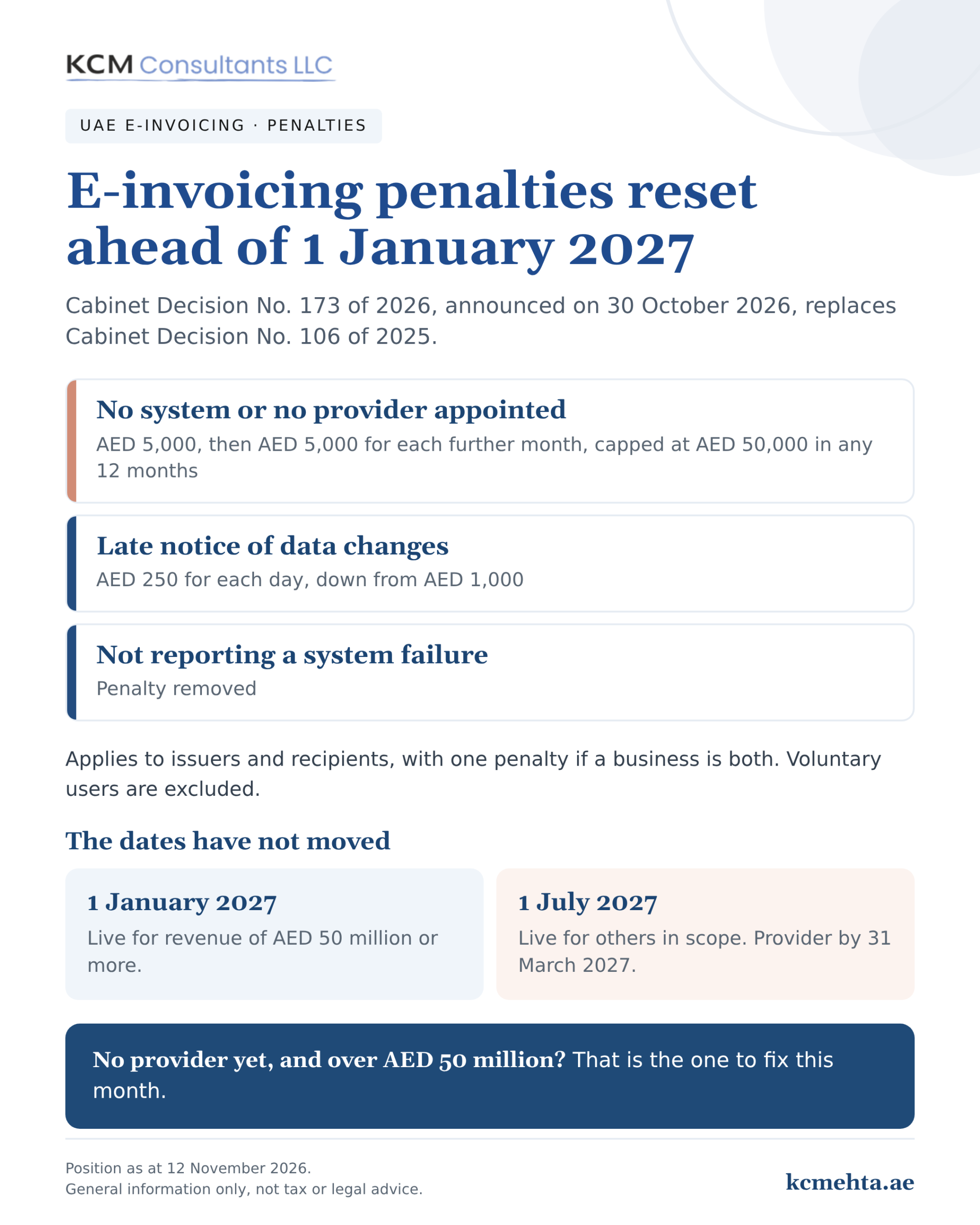
The UAE Cabinet has issued Cabinet Decision No. 173 of 2026, establishing the revised framework governing violations and administrative penalties arising from non-compliance with the UAE E-Invoicing System legislation. The Decision repeals and replaces Cabinet Decision No. 106 of 2025, setting out the administrative penalties applicable to violations relating to the implementation and operation of the E-Invoicing System.
What has changed
| Violation | Administrative penalty under the new Decision |
|---|---|
| Failure by the Issuer or Recipient to implement the E-Invoicing System, including failure to appoint an Accredited Service Provider | AED 5,000 for the first instance, plus AED 5,000 for each month or part thereof during which non-compliance continues, not exceeding AED 50,000 within any 12 consecutive months |
| Failure by the Issuer to issue and transmit an E-Invoice or E-Credit Note through the System | AED 100 for each E-Invoice or E-Credit Note, up to AED 5,000 per calendar month |
| Failure to notify the appointed Accredited Service Provider of changes to data registered with the Authority | AED 250 for each day of delay or part thereof, up to AED 5,000 per calendar month (down from AED 1,000 per day) |
Additional considerations under the e-invoicing penalty framework
- Recipients are liable: Recipients of E-Invoices may be subject to administrative penalties, in addition to Issuers.
- One penalty per violation: Where the same Person acts as Issuer, Recipient or both for the same violation, only one administrative penalty applies.
- Voluntary adopters are excluded: A person who issues, transmits, shares, exchanges or reports E-Invoices on a voluntary basis is outside the scope of the Decision.
UAE e-invoicing implementation timelines
| Business | Appoint an Accredited Service Provider by | Go live |
|---|---|---|
| Revenue of AED 50 million or more | 30 October 2026 (passed) | 1 January 2027 |
| Revenue below AED 50 million | 31 March 2027 | 1 July 2027 |
| Government entities | 31 March 2027 | 1 October 2027 |
What to do now
- Appoint a provider immediately: Businesses with revenue of AED 50 million or more that have not yet appointed an Accredited Service Provider should do so now, because the non-implementation penalty accrues monthly.
- Test before go-live: Systems, invoice and credit note formats, and customer data should all be tested before 1 January 2027.
- Smaller businesses: These have time to select an Accredited Service Provider before 31 March 2027, but should start early.
KCM Consultants supports businesses with e-invoicing readiness reviews and provider coordination. To discuss, contact Suril Mehta at suril.mehta@kcmehta.com.
Sources:
- Cabinet Decision No. 173 of 2026, announced by the Ministry of Finance on 30 October 2026
- Ministerial Decisions No. 243 and No. 244 of 2025, as amended by Ministerial Decision No. 66 of 2026
Disclaimer: General information only, not legal or tax advice. Position as at 16 November 2026.
Related
- UAEBusiness Tax
UAE tax updates, November 2026: e-invoicing penalties, top-up tax and the 31 December deadlines
E-invoicing starts 1 January 2027 with new penalties, top-up tax registration closes 30 November, and five UAE tax deadlines fall on 31 December.
Suril Mehta16 Nov 2026 · 15 min - UAEBusiness Tax
VAT on employee costs: what is recoverable from 1 October 2026
Since 1 October 2026, UAE businesses can recover input VAT on six types of free employee benefits under FTA Decision No. 17 of 2026, if strict conditions are met.
Suril Mehta13 Nov 2026 · 2 min