
Practical Guide on UAE Foundations
A Practical Guide to Private Wealth Structuring
By KCM Consultants
Published 23 July 202610 minDownload PDF
UAE Foundations
The foundation structure has rapidly emerged as a cornerstone of the UAE’s private wealth ecosystem. This guide provides a practical overview of the foundation structure, its key features, participants, and mechanics, followed by a comparative analysis of the three UAE jurisdictions where foundations can be established: ADGM, DIFC, and RAK ICC.
Introduction
Since the Abu Dhabi Global Market (ADGM) pioneered the region’s first foundation framework in 2017, followed by the Dubai International Financial Centre (DIFC) in 2018 and the Ras Al Khaimah International Corporate Centre (RAK ICC) in 2019, adoption has accelerated dramatically, from just 128 registrations per year in 2020 to an estimated 700 by the end of 2025, representing a near 5.5-fold increase[1]. This surge mirrors the UAE’s broader trajectory as a global wealth hub; the country is projected to attract the highest net inflow of millionaires globally, with 9,800 high net worth individuals expected to relocate, bringing an estimated USD 63 billion in wealth.
Combining the governance discipline of a corporate entity with the protective features of a trust, the UAE foundation offers families a flexible, private, and tax-efficient vehicle for asset protection, succession planning, and intergenerational wealth transfer.
What is a Foundation?
Core Concept
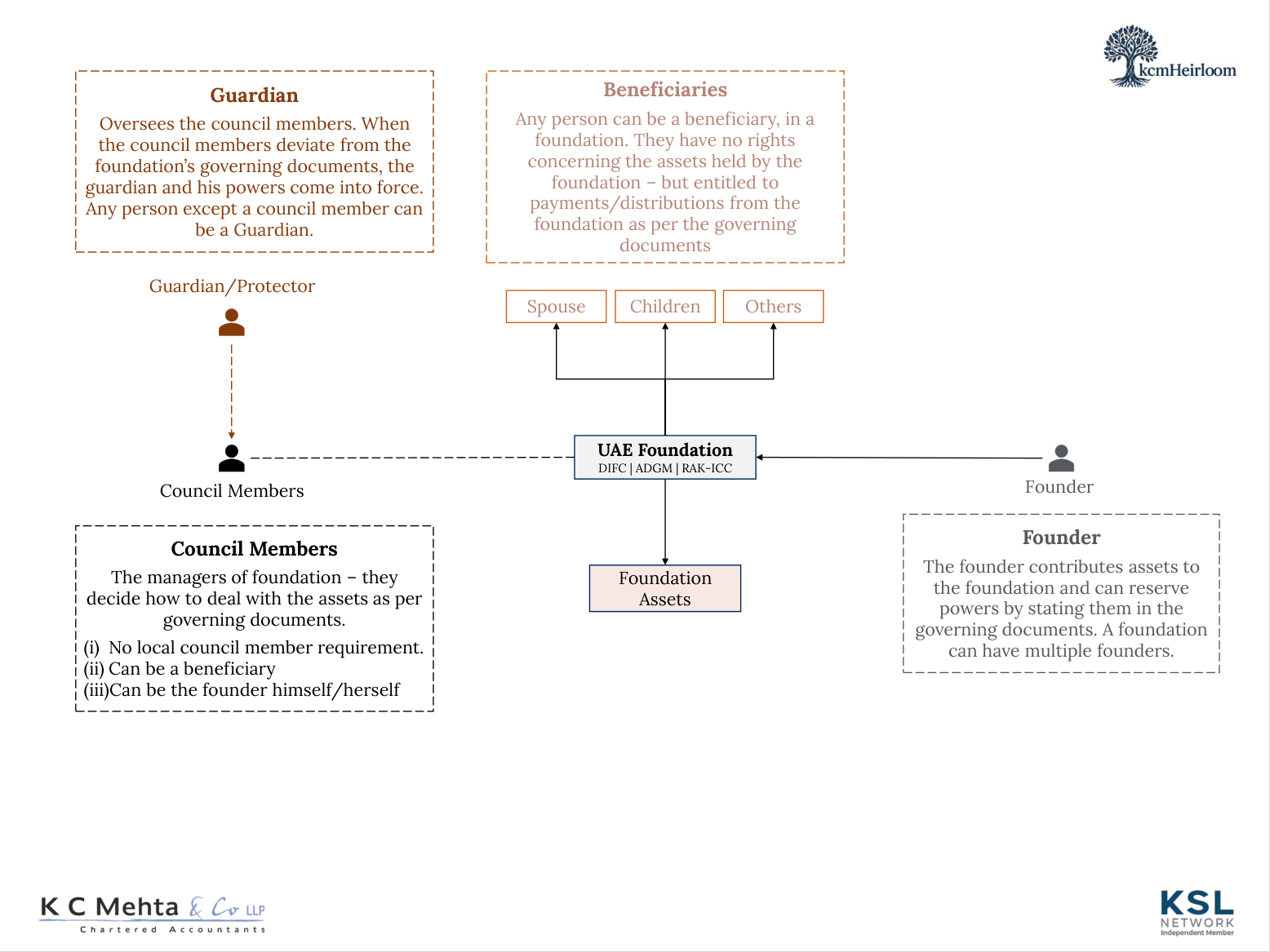
Those of us familiar with trusts will find the foundation concept intuitive; both structures hold and manage assets for the benefit of designated persons. However, unlike a trust, where a trustee holds legal title on behalf of beneficiaries, a foundation is an independent legal entity that holds assets in its own name. The founder(s) contribute assets to the foundation, and once contributed, those assets belong to the foundation itself.
The beneficiaries (typically family members) are entitled to benefit from the foundation but hold no ownership interest in it. Day-to-day management is carried out by the Council, functioning much like a company’s board of directors.
Key Participants
Founder(s)
Contribute assets to the foundation. The founder can reserve powers by stating them in the governing documents, and a foundation can have multiple founders.
Council
Carries out day-to-day management, much like a board of directors. There is no local council member requirement; a council member can also be a beneficiary or the founder.
Guardian
Oversees the Council and ensures compliance with the charter and by-laws. The guardian’s powers come into force when council members deviate from the governing documents. Any person except a council member can be a guardian.
Registered Agent
A professional consultant responsible for statutory compliances.
Beneficiaries
Any person can be a beneficiary. They hold no rights over the assets of the foundation but are entitled to payments and distributions as per the governing documents.
The key feature, at the cost of repetition, is that a foundation is an independent legal entity that holds assets in its own name and in its own right. While not strictly a hybrid of a company and a trust, it shares functions and mechanisms with both. What sets it apart is its unique position: it has no shareholders, no members, and no beneficial ownership in the traditional sense. It is a so-called orphan structure. This makes it particularly suited for long-term, purpose-driven asset holding.
Why Use a UAE Foundation?
With foundations, there is an additional question, “Why would I use a foundation over a private trust?” For this question, the answer is pretty simple. It is totally up to you. If a jurisdiction offers you a choice between a trust and a foundation, you can choose either, and fundamentally there would be no big impact on your estate plan. It is like deciding between a water bottle and a water pouch; these are essentially the same things serving the exact same purpose, except that they look and feel different. However, a trust has no separate legal identity, whereas foundations have a separate legal identity. Further, some jurisdictions offer only foundation structures (and do not recognize trusts) whereas others have it the other way around, so it is not really a choice in such cases.
Continuity Meets Customisation
Avoidance of the Probate Process
In the UAE, including free zones, wills must undergo probate before estate distribution. Probate is a court-driven process that is inherently slow and may be further delayed by disputes from heirs or creditors. Until completion, the estate remains frozen under an executor or administrator, with legal and administrative costs accruing.
A foundation avoids this entirely. Once assets are transferred, ownership vests in the foundation, not the individual. Upon death, the will has no effect on such assets, and the foundation continues uninterrupted without probate.
Flexibility
Foundation regulations set the structural and legal framework while allowing founders flexibility to shape internal workings. Key matters, such as council powers, the founder’s reserved powers, composition of the council, the guardian’s powers, distribution mechanisms, and amendment procedures, are provided as default rules, subject to modification through the charter and by-laws.
A foundation has two constitutional documents, the charter and by-laws, analogous to a company’s memorandum and articles. Subject to limited regulatory constraints, governance and decision-making provisions may be placed in either, offering significant drafting flexibility.
The Estate Planning Fundamentals
Tax Transparency
Where a UAE family foundation undertakes no business activity and has only individual beneficiaries, it may be treated as tax transparent and not taxed in its own right[2]. Its income is attributed to, and taxed in the hands of, the beneficiaries as if earned personally.
In the UAE, for individuals, personal investment income, real estate income, wages, and business income up to AED 1 million turnover are exempt[3]. Accordingly, where beneficiaries are individuals, income from securities and real estate held through the foundation is effectively not taxed.
Ring-fencing of Assets
Perhaps the most compelling advantage of a UAE foundation is the legal wall it erects between the founder’s personal estate and the foundation’s assets.
As stated in the foundation regulations of all jurisdictions, once assets are transferred to a foundation, they become the property of the foundation (as a separate legal entity). This means they are insulated from creditors of the founder, legal claims against the founder and foundation assets (including foreign ones), and the uncertainties of probate.
Interplay with Foreign Laws
Overriding Foreign Laws
Foundations established in any of the three UAE jurisdictions are governed by common law[4], with the ultimate authority resting with the relevant jurisdiction, overriding conflicting foreign laws. The regulations of all the jurisdictions state that any transfer of assets to the foundation and any distribution to the beneficiaries shall not be void on account of any foreign statute, judgement or order of a foreign court or any foreign rule of heirship.
These are very strongly worded statutory mandates in all three UAE foundation regimes. While they are yet to be tested in the relevant jurisdictional courts, in certain scenarios these provisions would most certainly provide significant weight against cross-border claims on the foundation property through the founder.
Escape from Forced Heirship
Forced heirship regimes, such as France’s réserve héréditaire, Scotland’s legitim, and the UAE’s faraidh, grant fixed shares to heirs, limiting testamentary freedom. For non-Muslims in the UAE, a registered will governs succession, with an option to elect home country law[5]; however, foreign forced heirship rules may still apply. For example, in the case of French-domiciled[6] individuals whose movable assets are governed by French law regardless of location[7].
A UAE foundation breaks this link. As assets vest in the foundation, they fall outside the estate and are not subject to probate or succession laws, including foreign forced heirship. These UAE free zone laws expressly provide foreign forced heirship protection and allow the by-laws to govern distributions, enabling flexible succession.
Selecting the Right Jurisdiction
The decision of incorporating a foundation involves factors common across jurisdictions and those which make a specific jurisdiction lucrative. ADGM, though being the first to roll out such regulations, still maintains the most flexibility pertaining to foundations, with lesser intervention of the court and registrar. DIFC and RAK ICC offer clearer procedures and newer concepts, such as conversion of foundations, but confer a wider range of powers to the authorities.
| Factors | ADGM | DIFC | RAK-ICC |
| Legal System | Common Law | Common Law | Common Law (option to select courts of ADGM or DIFC) |
| Minimum Initial Capital value (any kind of asset) | $ 100 | No such requirement | $ 100 |
| Statutory fees on incorporation | $ 1,000 | ~$ 1,400 | ~$ 3,800 |
| Tax transparency | No UAE tax on foundation’s income | No UAE tax on foundation’s income | No UAE tax on foundation’s income |
| Reserving powers for founders | Broad list of powers with no time limit of reservation | Powers limited to amending charter & by-laws and termination of foundation. Time limit: Lifetime (individual) or 50 years (legal person). | Same as DIFC, but includes power of investing activities and appointment / removal of council members & guardian. |
| Privacy & Confidentiality | Public information: details of the foundation and registered agent [10] | Public information: details of the foundation, founder, council members and registered agent. The charter can be accessed by a person with sufficient interest [11]. | Complete confidentiality |
| Ring-fencing – Clawback period [12] | Not expressly mentioned | 3 years from the date of transfer to the foundation | 3 years from the date of transfer to the foundation |
| Annual filing | No such provision | Mandatory to file annual accounts | Mandatory to file annual return |
| Risk of dissolution by the authorities (and consequent transfer of remaining foundation property to the authorities) | No such provision | DIFC Authority can apply to the court for dissolving the foundation if its registration is prejudicial to the interest of DIFC. | Same as DIFC (the authority in this case is RAK ICC Authority) |
| Migration and Conversion | Migration of foundations to ADGM from other jurisdictions and vice versa is permitted. | Migration of foundations to DIFC and vice versa is permitted. A company can be converted to a foundation. | Same as DIFC |
| Guardian Appointment | Mandatory after the founder’s demise | Not mandatory if the beneficiaries are the founder’s family members. | Same as DIFC |
Closing Remarks
The UAE foundation offers what few structures can: legal separation of assets from the founder’s personal estate, avoidance of probate, statutory protection against foreign heirship claims, and a high degree of flexibility in how wealth is governed and distributed across generations, all within a credible, regulated, common law environment.
Structure is Only as Strong as its Design
The choice of jurisdiction matters. As this guide illustrates, ADGM, DIFC, and RAK ICC differ meaningfully on confidentiality, the founder’s reserved powers, filing obligations, and the extent of regulatory intervention.
Charter vs. By-Laws: A Critical Decision
The allocation of provisions between the charter and the by-laws demands careful thought; a misstep here can cost future generations in time, money, or both.
Not Off the Shelf
A UAE foundation is not a product to be purchased off the shelf. It is a bespoke legal structure that demands careful design, precise documentation, and informed jurisdiction selection.
References
[1] Report by International Comparative Legal Guides, iclg.com
[2] Article 16 (unincorporated partnership is not a taxable person) and Article 17 (family foundation being treated as an unincorporated partnership) of the Federal Decree-Law No. 47 of 2022.
[3] Cabinet Decision No. (49) of 2023.
[4] ADGM and DIFC are free zones governed by common law principles, while RAK ICC allows foundations to select ADGM or DIFC courts for governance.
[5] Federal Decree-Law No. 41 of 2022 on Civil Personal Status.
[6] Domicile is where you have your permanent home. Different from Residence and Citizenship. It is where you intend to return one day for good.
[7] This is as per the rule of private international law called lex domicilii.
[8] Note that this transparent status and the tax benefit itself is not automatic; it is subject to fulfilment of certain conditions mentioned under law as also an approval from the UAE tax authorities. Applies to all 3 jurisdictions.
[9] Though it is widely believed that the charter is a publicly accessible document, in our opinion there is no such statutory right given to the public. Also, this point excludes the disclosure that the registrar of foundations is required to make to any government authority/body/regulator pursuant to any applicable laws or regulations.
[10] As available in the public register maintained by ADGM.
[11] A person with sufficient interest consists of the founder, guardian, council members, registered agent, assignee of rights, an unpaid beneficiary, a person appointed under by-laws and a person so determined by Court.
[12] A clawback period is a statutory window during which creditors can challenge and reverse asset transfers to a foundation. Once expired, such claims become time-barred and legally unenforceable.
About kcmHeirloom
KCMHeirloom is a specialized publication by the Succession Planning team at K C Mehta & Co LLP, focused on inheritance planning, estate structuring, and family business governance. It explores key challenges, evolving regulations, and best practices in wealth succession, offering valuable insights for families, business owners, and trustees.
While reasonable care has been taken to ensure accuracy, it should not substitute professional advice. Readers are encouraged to seek expert guidance before making decisions.
Reproduction of any part of this document requires prior written permission from K C Mehta & Co LLP.